Thursday, May 23, 2013

Artist Interview :: David Kasman


Get to know a Copley artist! David Kasman's works are currently featured in our "Fine Arts Work Center Fellows" exhibit in the upper gallery. A fellow in 2008, David spent the month of September in Provincetown, MA focusing on his loose, painterly canvases and abstract sculptures. Recently, the Co|So staff interviewed one of our multi-talented members about this work and his artistic career. 


1. Tell us about your work in the Fine Arts Work Center Fellowship Show.

They run the spectrum, but they were all painted from direct observation as opposed to working from photographs. It is a personal thing, but I cannot think of a single great painting, a painting that I really love, a single masterpiece, that was based on a photograph. When you boil it all down, a painting done from a photograph is a painting of a photograph; a painting done from life has the potential to convey something more visceral. My four paintings in this show focus on different aspects of the real world. The sailboat is about light, the dining room is about color, the Monhegan Blizzard is about atmosphere and the T-Rex is about plastic realization. 

David Kasman, Dinner Party Remains, 29 x 33, oil.

2. How would you characterize the arc of your career?

My first sculptures were abstract, wood pieces and, to this day, I consider abstract composition to be at the heart of all my work. From there, I spent a number of years focused on, so called, representational sculpture.  In 2002, I tried my first oil painting. Painting had not interested me until that point, because I had no real understanding of it. Once painting got a hold of me though, I couldn’t stop that either. And now, everything has fused together. My paintings have become more solid and my sculptures have become more fluid and painterly.


3. When did you realize that you wanted to become an artist?

When I was at Cornell, my sculpture professor, Jonathan Squire, saw my enthusiasm and he was encouraging me to transfer into Cornell’s Arts and Science School to become a sculpture major. As much as the idea appealed to me, I didn’t consider sculpture to be a realistic career option. But, life has a way of presenting second chances, so after I sold my laboratory equipment business in 1999, I decided to make my move and become a full time sculptor. Later, I added oil painting to my endeavors. I should mention that I am not comfortable calling myself an “artist”. To me, “artist” is a loaded term. Other people may label me that, and that is fine, but I call myself “a painter and a sculptor”.

David Kasman, Reflections at Dusk, 22 x 25, oil.

4. How did FAWC affect your art/artistic voice?

The biggest effect was from contact with the Mass College of Art, MFA students. Everybody except me was in that program. When you cut through everything, what the professors and students were completely obsessed with was doing something new, that is, breaking conventions and traditions as well as pushing limits. Of course, I had already thought about this to some degree, but confronting and addressing this goal, every single day, had a positive and important impact on me.

David Kasman, T-Rex, 21 x 25, oil.

5. Describe a poignant moment/experience from your time in Provincetown.

There were a few MFA students that I used to hang out with during my stay at the FAWC. One of them told me that his professor had suggested that we might think about our earliest interests as sources for inspiration, as clues to our most elemental interests. My earliest obsession was dinosaurs, or more specifically, fossilized skeletons of dinosaurs. Suddenly, I realized that perhaps I should develop larger and more fossil-like versions of my sculptures! The results of this realization will form the core of my upcoming 2014 Copley Society solo show. Stay tuned …

Thursday, March 21, 2013

Artist Interview :: Tom Stocker


Get to know a Copley artist! Tom Stocker's trompe l'oeil depiction of a carpet vibrantly exudes texture, and is one of the stand-out works on display in our "Winter Members Show: Elemental." Recently, the Co|So staff interviewed one of our brilliant members about this work and his artistic career. 

1. Who is your greatest influence?

I have always been drawn to the colorful, the primitive, and the exotic, so it follows that I would admire the work of Delacroix, Gauguin, and Matisse, who all looked to the Orient for inspiration. Matisse especially had an eye for the patterns seen in fabrics and oriental rugs, a taste acquired from his father's family business. The names of artists throughout history such as Bellini, Holbein, Lotto, and Memling are in the lexicon of oriental rug studies.


2. Tell us about your work "Dragon and Phoenix" in the Winter Members’ Show: Elemental.

My painting, "Dragon and Phoenix" is a faithful interpretation of a historic rug fragment in Berlin's Museum of Islamic Art. Ironically, Armenian letters are found in the composition, indicating a Christian origin. Beyond the history lesson, the painting illustrates the connection between the "craft" of weaving, a product of the loom's grid, and contemporary art's frequent reference to the grid as its fundamental base. Another version I made of this painting is in the collection of the Armenian Library and Museum of America.

Tom Stocker, Dragon and Phoenix, 31.5 x 31.5, acrylic on canvas.
  3. How would you characterize the arc of your career?

My career as an artist has always been rooted in my love for oriental rugs and textiles. After twenty years of painting full scale interpretations of carpets, some as commissions for collectors and corporations, the recent recession necessitated a turn to smaller, more diverse subject matter. I quickly realized that my tactile, pointillist technique which emulates a textile, could be adapted to any subject producing intriguing effects, even in portraiture. But I always return to my first love, the carpets of the nomads, tribes and villages of the Mideast.


4. Did you attend an art school?

In the mid 1960's, I attended on scholarship Boston's School of the Museum of Fine Arts, which at the time still adhered to a strict, academic curriculum. Freshmen studied painting, sculpture, anatomy, perspective, composition and design, art history, ceramics, and took three hours of drawing from a live model SIX days a week.


5. When did you realize you wanted to be an artist?

My grandfather in his retirement used to make braided rugs in his workshop. He would let me quietly watch the process from cutting and dying the wool to the weaving. Seeing the process from shapeless scraps into a colorful, beautiful pattern was magical for a small child. I learned that it was as much about patience as concept and skill. I wanted to be like that!

Saturday, February 23, 2013

Co|So Exhibitions :: Small Works: Sterling


Currently on display in the lower gallery of the Copley Society of Art is Small Works: Sterling. Sterling features over 150 small works from our artist members, and showcases the diversity of media, subject and style represented at Co|So. In particular, a group of small works display the less common media that some Co|So artists utilize to great advantage.

John Montiero, Jack in the Box #1, 10 x 8, scratchboard.

Copley Artist John Monteiro employs scratchboard to explore form and line in a series entitled Jack in the Box.  Monteiro, a native of Boston, creates depth in his etchings through the use of intricate lines and a variety of techniques.  When viewed closely, the sophisticated amount of control needed to master such an unforgiving medium becomes clear, as the artist is not able to erase any mistakes. A subtractive method, scratchboard highlights Montiero’s skill and detail-oriented draughtsmanship.

Marilene Sawaf, Woman, Hat and Bird, 11 x 9, casein.

Another exciting use of an unusual medium are two works by Marilene Sawaf, entitled Woman, Hat, and Bird and The Arrival, which are painted using casein, a type of tempura paint made with milk protein.  Sawaf’s paintings possess a strong aesthetic similarity to the bold, even colors of stained glass, which she states is inspired by a stained glass window from her grandmother’s house in Alexandria, Egypt.  Casein is similar to acrylic paint in the bright, undiluted colors produced. Sawaf has incorporated the boldness of pure colors into her art to augment her artistic voice.

Jason Eldredge, Dingies, 9.25 x 11.25, woodblock print.

Jason Eldredge presents an uncharacteristic medium in his work Dingies, a woodblock print.  Eldredge, who resides in Cape Cod and primarily paints in oil, utilizes the graphic nature of woodblock to represent crashing waves and wooden boats piled along the shore.  By only using three colors, Eldredge allows texture to be at the forefront of his piece, creating a satisfying contrast between wave, wood and sand.

Ten artists, including the three mentioned above, were honored with Awards of Merit for the skill, quality and technique exhibited in their work. The Awards of Merit for Small Works: Sterling were given to Patrick Anderson, Leigh Campion-McInerney, Brian Dubina, Mary Graham, John Monteiro, Nick Read, Robin Samiljan, Marilene Sawaf, Kate Sullivan, and Derek Uhlman.

The show will be up until April 25, 2013 – we look forward to seeing you in the gallery soon!

Thursday, February 7, 2013

Artist Interview :: Sean Farrell

Get to know a Copley artist! Sean Farrell's stunningly realistic Italian still-life paintings are currently on display in a solo show titled "A Glance of Rome." The works can be viewed at Boston Private Bank in the Prudential  Center. Recently, the Co|So staff interviewed one of our accomplished members about this work and his artistic career.  

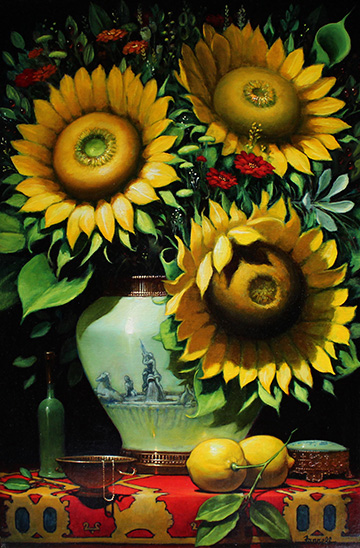
Sean Farrell, Sunflowers Over Rome, 38 x 28, oil on linen.

1. Who is your greatest influence?
My greatest influence has been my family. Growing up, I learned from my parents, grandparents, aunts and uncles that you could be whatever you want to be if you follow your heart, set your mind to it, work hard, and stick with it. This is probably why my sister, my brother and I all work for ourselves and each do something we love.  
       In terms of artists, my greatest influence is all those who came before me. Every artist is inspired from and learns from the past. We are moved by art we see, for reasons we sometimes may not know right away, and this inspires us to create for ourselves. If a work of art was truly inspired, something comes through from any time and any period. Over time, one develops one's own sense of what is appealing and desired for his/her own work. By paying attention to what appeals to you and what is within you, you can take it and create something that you have not yet seen, but wish to create and to see for yourself. I believe this is the process of any great artist.      


2. Tell us about your work in A Glance of Italy.
 The exhibit "A Glance of Italy" features works that take inspiration from my travels in Italy.  I have travelled quite a bit in Italy over many years to see and study in person the Italian art that I love. While doing so, I also fell in love with the beauty of Italy as a country as well, and the paintings in this show share some of what I have experienced. Below, I'll share a little about two of the paintings on display.

Sunflowers over Rome 
I created this piece to express some of the joys I have taken away from Italy. Throughout Italy I see a great care for small things. The flowers, the food, the handmade items and simply for the care to notice and have beauty around oneself in everyday life, be it large or small. In Tuscany, I saw wonderful sunflower fields that inspired me to grow my own flower gardens here at home with lots of sunflowers. The vase in the painting is created from my imagination, and it includes a design depicting a large Bernini sculpted fountain from a favorite central city square in Rome. There I have enjoyed painting and sketching in the Piazza Navona. Hence the title, Sunflowers over Rome.

Sean Farrell, A Glance of Rome, 34 x 28, oil on canvas.
A Glance of Rome
The inspiration for this piece came one day when I was walking through the Villa Borghese park in the middle of Rome. I had my french easel on my back, intending do a painting of a fountain that I had sketched earlier. I entered the large park from the Piazza del Popolo, and to enter the park from this square one must ascend a long steep flight of stairs. At the top of the stairs I was quickly stunned by the site of beautiful mandarin tree in full blossom of its fruit. Wow! In February! I just had to paint it then and there. After painting close ups of the mandarins on the tree, I did this piece, A Glance of Rome.


3. How would you characterize the arc of your career?
I have been quite fortunate with my art career. I have been doing it full time for the past twenty years. Though I started out my working career employed by advertising and software companies, and doing my art on the side, I recognized fairly early on that I had such a great desire to make paintings and that I simply could not put it aside.  I really needed to be an artist, and work at it as much as I possibly could. As such, I saved as much money as I could for one year and then finally quit my job. Most people would have perhaps put a down payment on a house or condo with the money I had saved, but I had decided to use this to launch my professional art career.
When I had my 1st showing of my work, I sold six paintings on the first day, and soon had representation with 5 galleries.  Each year, sales got better and so did my paintings. As sales increased, I traveled to study more great works of art. Soon I was going to Europe fairly often to do this. Over the past two years, sales have been spotty at times with the economy, but I keep working to improve upon my work. In my mind, I see where I want it to go with it, and I keep striving to make my paintings better to my eye. Over time it all adds up. As I say, it is a lifelong process of continually trying to make a great painting.  


4. Did you attend an art school?
No I did not attend art school.  Instead, I have learned much by traveling extensively to study directly the works that I love. I try to take away elements of great works that I find useful and incorporate those elements into advancing a vision for my own work. I take away and work at what appeals to me and leave out the rest. I think somehow this has made my work unique in the sense that I do not try to paint as I've has been instructed by another, but only as I've been instructed by my own image of what makes a great painting. I am still learning.


5. When did you realize you wanted to be an artist?
I first realized I wanted to be an artist in the 5th grade. I had a friend who also loved to draw, and we drew all the time. That was an artist to me. I did not realize that people actually earned a living from their art in the modern day and age until I was an adult.  As soon as I discovered this, I saw it as a means to an end of having the time to try and make best paintings I could. If the sales of my artwork provided the opportunity for me to paint all day and every day, I could make progress. I quit my day job twenty years ago and never looked back.

Saturday, January 19, 2013

Artist Interview :: William Turner


Get to know a Copley artist! Currently on display in the New Members Show is William Turner's humorous and thoughtful painting  "Hermes and the Infant Dionysos." Recently, the Co|So staff interviewed one of our newest members about this work and his artistic career. 

William Turner, Hermes and The Infant Dionysus, 40 x 30, oil on canvas.

1.       Who is your greatest influence?
Many contemporary artists have influenced me over the years, but mainly all art that evokes an emotion without offending is what I like best.   Sometimes it is the technique, other times the use of color, application or subject matter.  As in music, a good song stays in my head, while others drift away.


2.       Tell us about your work in the New Members’ Show 2013.
For many years I have chosen to paint machinery as metaphors for humans.  In search of rusted machinery I have taken many sketches, notes and photographs of these as I find them throughout New England.  The massive Sterling dump truck in this painting is one of them.  It had on its hood a rusted toy Tonka truck.
     It was a five years later when working on a series inspired by mythology and classical art that I remembered this truck.  To refine my notes I went back to the location where I had seen it, hoping it hadn’t been sold or destroyed.  There it sat with the Tonka still on its hood.   It brought to mind the Greek statue of Hermes and the Infant Dionysos with which I am very familiar.  As Hermes was charged to care for the infant, so too this massive Sterling has bonded with this little replica on its hood.  


3.       When did you realize you wanted to be an artist?
4.    How would you characterize the arc of your career? 
My career in art has been one of intermission.  My mother was a fine artist and at a young age taught me the basics of drawing which I used to great advantage during my years in junior and high school.  However, there was what seemed an insurmountable drawback to pursuing a career in art at that time.  I was dyslexic.  Dyslexia was not diagnosed or even talked about during those years.   I didn’t have the grades needed or the accommodations which are available today to go to college.  After serving in Vietnam I returned home to start a career working with machinery and vehicle restoration but always drew or painted in my spare time.     


5.       Did you attend an art school? 
It wasn’t until mid-life that I decided to train professionally and attended the Manchester Community College where  I studied design and commercial illustration.  This gave me the confidence to try attending a four-year college.  I enrolled in New Hampshire Institute of Art in Manchester and enjoyed my experience working in different art venues.  I chose to concentrate on painting and graduated in 2006 with a BFA in painting.   These years have been the most challenging but most rewarding of my life since I can combine my love of machinery and art.  I continue to take courses that will encourage me to explore new and various ways to express my art.